Bipolar Disorder: Egosyntonic or Egodystonic?

The concept of egosyntonicity comes from the days of Freudian analysis, although it is still used among psychologists all over the map of treatment modality. Basically, an egosyntonic syndrome doesn’t come into conflict with the self — whereas an egodystonic condition does create inner conflict and, in doing so, causes significant distress.

Here are some examples:

  • Egodystonic: OCD, depression (usually), anxiety
  • Egosyntonic: Autism, eating disorders, euphoric mania, narcissistic personality disorder

Since bipolar disorder changes over time, for me, it fluctuates between egosyntonicity (in euphoric mania) and egodystonicity (in dysphoric/mixed mania and depression). That said, as I’ve come to have a great deal of insight into my bipolar disorder, it’s actually become increasingly egosyntonic. I’ve accepted the diagnosis that I received at 17 years old.

I mean, I even suspected I was bipolar for quite a few years before my official diagnosis when I went away to … but I had a rebellious phase around 19-20 years old. I was involuntarily hospitalized twice in less than a year, which at the time seemed like a lot. (After my career at UCLA, it doesn’t seem like nearly as much now.)

What about you? Would you say bipolar disorder is moreso egosyntonic or egodystonic?


Bipolar Disorder vs. Manic Depression: Importance of Lived Experience

You may have heard that Bipolar Disorder used to be known as Manic Depression. This was the case until 1980, with the advent of the DSM-III. The committee over at the APA who decides these things had three goals in mind when they changed the name:

  1. Reduce stigma — The APA saw that the term “manic depression” had become highly stigmatizing.
  2. Provide a more accurate and clinical description of the condition
  3. Reflect the alternating periods of mania and depression that characterize the disorder — more on these in a minute.

I want to clarify that while the APA laid out the missions above, they did not consult the community members who live with the condition. Many people, some of them high profile (like Kay Redfield Jamison) still prefer the term manic depression still today. To change the name of a disorder without extensive community feedback feels like a violation of autonomy for those of us who live with a severe mental illness.

But let’s address the three goals laid out by the APA with the publication of the DSM-III…

  1. Although it’s very likely true that the term “manic depression” had become highly stigmatized, it seems a bit odd to assume that the stigmatization of the disorder came from what we choose to call it, rather than stemming from the people who live with the condition. Case in point, today “bipolar” is highly stigmatized and used inappropriately for a number of reasons — to refer to indecisive weather patterns, people we don’t like, and a host of other things. It’s just as bad as manic depression ever was. Why? Well, maybe the problem wasn’t the term manic depression. The stigma was never attached to the term. The stigma is attached to those of us who live with the condition, regardless of what you choose to call it. No matter how many times you change the name of the disorder, that truth would never change.
  2. Many of us in the bipolar disorder/manic depression sphere actually feel that “manic depression” is much more descriptive of our lived experiences. “Bipolar” exemplifies a particular phenotype, one which is at least somewhat common among bipolar folks (and considered by some to be an archetypal presentation) but to the exclusion of others with more uncommon manifestations of the disorder. If we are to take “bipolar disorder” at face value, I am left to assume that there are two “poles” (opposites) which people oscillate between. However, this ignores the very real and unfortunately common experience of mixed episodes — when the two opposing states of “bipolar” are somehow happening both at the same time. How can they be opposite, when in fact they coexist so frequently?
  3. I don’t think most people who know little about “bipolar disorder” are thinking about its longitudinal dynamics. Many people still believe that bipolar disorder is about quick shifts in mood lasting only a few hours (although these types of episodes do happen in classic bipolar disorder, they are much more rare and occur in the context of other well-known symptoms) or that bipolar disorder is the same as “multiple personality disorder”.

As it turns out, I think manic depression is both more accurate (instead of positing that mania and depression are opposing forces, when in reality, they seem to be linked and can even occur simultaneously) and, in the end, probably less stigmatizing than “bipolar disorder”. This just highlights the importance of including community input (for example, from “bipolar” patients) when making decisions like this.

What do you think? Leave a comment and let us know!


Things that I found useful living in the Upper East Side of Manhattan

About six months ago, I moved out of my parents’ home on Long Island. I had been living there since I graduated with my PhD in Psychology. About three years, I think. I was eager to have my own space and spent many hours looking at furniture, most of which I could not afford. My apartment is a studio, though it has two levels and separate bathroom and kitchen areas. It has a certain charm to it. (I did buy one piece of furniture over $150 or so — this dresser, in ivory. I love it, it’s perfect for my space.)

Anyway, this post is about things I found useful while living in NYC. Just as a disclaimer, I will link to the products I bought wherever possible, but I have not been paid off by any of these companies.

1. A small bag

A small backpack or crossbody bag is essential for traveling around in the city. Lately I’ve mostly been using a mini backpack from Timbuk2 that I picked up a few years ago, or a crossbody from Mokuyobi similar to this one. Avoid carrying anything with designer logos. They might make you a target for theft.

    2. ANC headphones

    As an autistic person, I wore these even in the suburbs, but the city is crazy loud. I highly recommend getting a quality pair of headphones with active noise cancelling (ANC) unless you’re in the minority of people for whom ANC causes motion sickness. I wear Bose QuietComforts. Wow, I’m eyeing that blue color!! Mine are just black.

    3. Hiking shoes

    It should go without saying that you need comfortable walking shoes in NYC. In the winter, however, sidewalks can get slippery. You’ll want a shoe with decent traction. Sure, you could wear boots, but most boots are rigid and difficult for me to get my foot into (due to my dyspraxia). But there’s a subgenre of sneakers with high traction: hiking shoes! I got (and love!) the Oboz Emma Low (in Charcoal).

    4. Neutrogena City Shield

    It’s important to keep moisturized, especially in the winter as aging heating systems make the air indoors very dry. It’s also important to protect your skin from the sun year-round. This is a product that does both, and it also contains antioxidants to protect skin from pollution.

    5. Fan

    Of course, having a fan to circulate air in the summer is a no-brainer, but if you don’t have space to air dry your clothing outdoors, you can use a fan to dry them.

    6. Scooter

    I know some people love their e-scooters but I’m talking about a manually powered kick scooter. I have a Micro Flex scooter, but an adult sized Razor will do. You can take it on the subway and you can ride on the sidewalk. Another option is a bicycle (or hybrid electric bicycle), if you’re confident enough to use the bike lane.

    Note that the Micro Flex is discontinued; if you think you might use the 2 year warranty, or you weigh somewhere between 220 and 250 lb, I recommend buying a Micro Suspension directly from Micro.

    7. Long johns

    NYC doesn’t usually get extremely cold, but each year there will be a handful of days that are frigid to the bone. Most people in the city walk and/or take public transportation everywhere they go. That doesn’t change just because it’s freezing outside. I recommend layering; easy enough to do with tops, just wear a hoodie, sweater, or sweatshirt under your coat. Bottoms are a little trickier. That’s where cold-weather underwear like long johns come in. I bought a nondescript pair from Amazon; wherever you prefer to buy them is just fine, I think Uniqlo sells them.

    8. Warmies stuffed animals

    Another cold weather hack, especially if you’ve got kids. Warmies are stuffed animals that come in a wide variety of shapes and sizes. They are scented with lavender, and have a pleasant weight to them, but that’s not the only thing they can do. Pop them in the microwave and they stay warm for quite some time.

    9. Sun lamp

    If you have bipolar disorder or depression, you’ve likely heard of these. You may be asking, do they really work? And the answer is… sometimes. The most effective ones are made by the company Carex and are 10k lux and 12″ wide. But they are ugly, so I got one made by Circadian Optics which is smaller, and it seems less effective, but it’s not ugly and it does have some effect. The time of use differs depending on diagnosis. People with depression should use it for one hour in the morning, while people with bipolar disorder should use it for one hour around midday. I use mine in the afternoon because I’m a rebel. But take this as your warning that using it at night or for more than one hour runs the risk of triggering mania.

    10. Minimalist wallet

    Okay, this one is less of a need in New York specifically, and more of something that’s nice to have in general. Paying attention to details like your wallet can also make you seem more stylish, which is good in a big city. I tried two minimalist wallets: one made by Ridge and one made by Ekster. In terms of size and weight, the Ridge wallet is smaller. It’s easy to operate; while the Ekster wallet has a trigger that makes your cards pop out, for the Ridge wallet, you simply push them out with your thumb. That said, I prefer the Ekster wallet. It’s pretty, and the trigger is quite cool. Note, however, that while any Ridge wallet is compatible with their AirTag options, using the Ekster wallet with an AirTag will require installing a plain black backplate or using one of the wallets that are specifically made for AirTag compatibility. You can’t use just any Ekster backplate with an AirTag strap.

    11. Adjustable belt

    When traveling around NYC, one encounters a lot of stairs, particularly in subway stations (many of which are not wheelchair accessible). This calls for having a good belt. But, being bipolar, I can gain or lose weight quite rapidly. I also need a belt that is easy to get on and off due to my dyspraxia. The belt I settled on is the Groove Life Belt (in Walnut/Brown). It adjusts, but securely, so it won’t fall down while you’re climbing all those stairs. It also has some slight stretchiness for comfort, and it is held together with strong magnets that are surprisingly easy to disconnect with a tiny bit of practice. I was concerned about going through any metal detectors because the magnets should set them off, but it hasn’t come up even once so far. Just be aware that might happen. I would just take the belt off at the airport, but I would do that with almost any belt since they usually have small metal components.

    12. Magsafe battery

    Ah, Magsafe. The future is here with wireless charging for iPhones. The future should be here for Android phones, too, but for some reason it’s not. If you have an Android I guess you’re stuck using wired charging. But if you’re like me and you have a reasonably new iPhone, you can stick a charger to the back of your phone and keep your battery going while you’re out and about. I just have a generic one myself, although I’ve eyed the Magsafe Power Banks made by Casely.

    13. Umbrella

    Yes, that’s right. In NYC it rains (and snows, and every step in between). I prefer having a clear umbrella so I can see where I’m going. I have one from Totes in color lemonade which has a cheerful yellow trim and handle.

    14. Indoors shoes

    Everyone knows the city streets are gross. Especially the sidewalks. Dogs pee on it. I recommend designating footwear for inside. Which you should choose depends on personal preference. Kizik hands-free shoes might be a good option, especially if you have private outdoor space. But sandals or slides or even slippers are all valid options here.

    That’s my list! Did I forget anything? Let me know in the comments!

    P.S. I know I didn’t include a granny cart. They are widely used in NYC, but I personally had a lot of difficulty using one.



    Neurodivergent App Review: Habitica

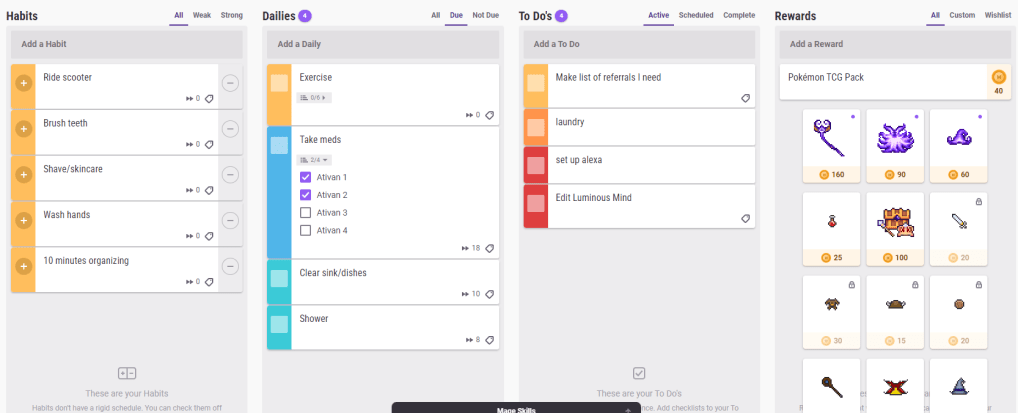
    It seems like everyone’s got their own favorite app for managing daily tasks and to-dos, but so far my favorite is Habitica. I think it could be really useful for neurodivergent people with the right personality — Habitica is very much a “menus” game. If you love fine-tuning and deep personalization, Habitica could be perfect for you.

    Habitica is available as both an app and a web interface. They both have utility, which I’ll discuss, and having both available may be great if you spend a lot of time at your desk. It is free with paid upgrades available; I haven’t paid for any upgrades and none of the features I’ll mention in my review are paid features. When you start playing (we are “playing” since Habitica is all about gamification, or turning your life’s to-do list into a game) you get a pixel avatar, which you can level up, equip items and pets to, and more. But the pixel avatar isn’t even the best feature of Habitica, in my opinion. You could play quite efficiently paying no attention to the avatar at all — more on this later.

    Set habits, dailies, and to-dos all in one app

    It’s possible to use two or even three different apps to track all of these kinds of tasks. A more precise definition:

    Habits: Tasks you want to do regularly (or reduce doing — habits can be negative), but that don’t have a fixed schedule for their occurrence.
    Dailies: Tasks you want to do at specific times, for example, every day, or every 3 days, or every Tuesday and Thursday.
    To-dos: Tasks you need to do once.

    Each task can have checklist items, which increase the value of the task. In fact, there’s a pretty crazy level of detail and precision that can be attained in the settings menu for each task. And the system can have a learning curve, but that in itself makes the system appealing for menus-type people.

    Pause damage as you need it

    For neurodivergent people, it’s important any app can be flexible to avoid overwhelming us. Habitica normally inflicts damage on your character for missing dailies — however, there is an option in the setting menu to pause damage. No damage will be inflicted on you until you turn damage back on again and there is no cost or downside to pausing damage. You can continue to get rewards as usual.

    Custom rewards

    Habitica comes with many built-in rewards, including items for your avatar, eggs and hatching potions (which create pets), and so on. But the primary currency of the game is gold, and you’re able to set custom rewards for in-game gold. I set up a Pokemon TCG pack for 40 gold. Any reward can be integrated into Habitica! Try using a preferred treat, video game time (or any favored activity), or small amounts of spending money as rewards.

    Personalization of the app and the web interface

    The Habitica app allows you to choose from an impressive number of color themes, sound themes, and even custom app icons. Meanwhile, the web interface allows you to see everything you have to do at once — and gives the option to toggle tasks that are not due today so that they are invisible.

    The thoughtful design and customization features of Habitica are what make it the best app I’ve used. It can be overwhelming, though, for people intimidated by those features. But it’s free, so why not give it a try?

    *I am not affiliated with Habitica.


    Medication review: Abilify (aripiprazole)

    Do you remember the TV commercials for Abilify? At the time, it was being marketed in such a way that a lot of people thought it was an antidepressant. It’s not, though. Abilify is most definitely an antipsychotic, primarily indicated for schizophrenia and bipolar disorder, and it comes with the full list of potential side effects that another antipsychotic might come with. When Abilify was first released, its manufacturer pushed a lot of half-truths (or null-truths) like “Abilify is weight neutral” (26% of patients experience clinically significant weight gain, albeit not as much as Zyprexa) and “Abilify doesn’t cause movement disorders” (it can cause tardive dyskinesia (TD), and 9% of patients experience akathisia — a profound inner restlessness that patients often describe as wanting to “crawl out of [their] skin”). Overall, 15% of patients experience a serious adverse drug reaction.

    All of that said… Abilify isn’t a bad drug.

    I took Abilify for four years before developing a TD-like movement disorder that ultimately led me to discontinue it. (The same movement disorder worsened on Vraylar, which is a very close relative of Abilify.)

    It might be fair to say that Abilify is misunderstood. I don’t think it should have been marketed the way it was. But when we’re talking about schizophrenia and bipolar disorder, well, it’s not the worst of the options. Clozapine and Zyprexa are worse for weight gain. Haldol is worse for movement disorders, like TD and akathisia. But is it effective?

    Actually, Abilify was pretty effective for me. When I first started taking it, I would sleep all day. I’d fall asleep in my classes, like, head-on-desk, passed out. (This was particularly troublesome in my class on child abuse.) Then I started taking a stimulant for my ADHD, and everything seemed to be in harmony. Until a new psychiatrist took me off of Abilify to try a newer drug (Latuda — which did nothing for me). When I eventually went back on, I had all kinds of weird side effects. I couldn’t sit, or even stand still — a condition that my psychiatrist would later describe as akathisia. And my head started to shake involuntarily.

    So how effective is it, really? The maximum dose of Abilify is 30mg, but benefit at doses higher than 15mg has not been established. A concept that is sometimes floated around in psychiatry is that of equivalent doses, usually CPZ (chlorpromazine) or OLA (olanzapine) equivalents. In this case, we’ll use haloperidol equivalents. 15mg Abilify is equivalent to 7.5 mg of Haldol which is also equivalent to a whopping 750mg quetiapine (Seroquel) — very close to the maximum dose of 800mg. We can see here that Haldol is stronger than Abilify, and Seroquel is weaker. We can tell based on the maximum dose of each and where the others stand in comparison.

    Think of it like this: the maximum daily dose of Haldol is 30mg. The equivalent dose of Abilify is 35 mg — above the maximum. So it’s a bit weaker than Haldol. Meanwhile, Seroquel is much weaker. (In fact, Seroquel is the lowest potency antipsychotic, and usually isn’t used to treat psychosis.)

    The moral of the story is not to trust the commercials put out by drug companies. I won’t be taking Abilify again, and unfortunately my movement disorder has never completely gone away. For some people, though, it’s a great medication.


    If Autism Isn’t a Mental Illness, What Is?

    My name is Elliot. I’m an autistic psychologist with bipolar 1 disorder (and ADHD). I’ve been mentioned in passing [1] [2] in news articles about autistic autism researchers, but I prefer to keep on the science side of things. I usually only use Twitter for personal entertainment, sometimes biting my tongue as I weigh the pros and cons of engaging in autism discourse. I don’t entangle myself too deeply in advocacy work. For the most part, I keep my opinions on controversial things low-key no matter which side I am on. This post is a divergence from that tendency.

    I have not uncommonly heard people object to classifying autism as a mental illness. It’s almost taken for granted that autism doesn’t fall under that umbrella. You may be surprised to know how people try to justify it if you actually ask them “Why isn’t it a mental illness?” Indeed, when pressed the most common responses are along the lines of:

    • “Autism is a neurodevelopmental disability” / “You’re born with autism”
    • “Autism isn’t an illness” / “Autism doesn’t need to be treated”
    • “Autistic people aren’t like *those* people”

    The common element in all of these responses is a lack of understanding of what mental illness is and what mentally ill people experience. The question I want to ask back is this: If autism isn’t a mental illness, what is?

    I’m not unsympathetic to the cause of not labeling people as having an “illness” because they’re neurodivergent, but why is it okay to do it to schizophrenic folks and not to autistic folks? There are plenty of mad people who don’t exactly view their diagnosis as an illness, although opinions in the psychiatric community are varied on this topic. Some consider diagnostic labels to be a prison, and others a gift. We sure live with plenty of labels.

    Pharmaceutical drug labels.

    Mental illness takes many forms. Some of them are quite properly classified as “neurodevelopmental disabilities” (including schizo spec, bipolar disorder, and ADHD — among possibly many others). The disorders I just mentioned are predominantly caused by genetics, and are therefore present at birth. The expression does change over time — but don’t autistic people have qualities that change as they grow and learn?

    People refuse to acknowledge the close similarities between autism and schizophrenia (and other severe mental illness).

    I’m going to flat-out recognize this: I think a lot of our community is biased. There are a lot of autistic people that are sanist, and they’ve been permitted to perpetuate misunderstanding.

    My own therapist once tried to convince me after I admitted to experiencing delusions earlier in the week that I was merely referencing thoughts that were “overly rigid” as a result of my autism. My psychotic symptoms were being falsely attributed to my autism, and a lack of care was being given where care was needed.

    And in the real world autistic people are at high risk of being mistaken for schizophrenic and taken to an ER for psych evaluation when they’re in distress. People can be treated horribly. But instead of stepping back and saying “Why do we treat mentally ill people horribly?” we’ve decided that allyship is not for us and we double down on “Autism isn’t a mental illness.” We cast non-autistic (and some autistic!) neurodivergent people as the Other.

    To be quite honest, I think some autistic people are scared of crazy.

    Perhaps they’re scared of people who may be erratic, hard to predict, or have dramatic emotional reactions.

    A person wearing black Converse and a blue hoodie.

    Are there reasons to set autism apart from conditions we consider “mental illness”? I just don’t see the justification for viewing autism as so singularly unique from other conditions. It’s possible that, in the future, we could redefine and do away with the label of “mental illness” altogether. I’ll be interested to see how language evolves for neurodivergent folks. I hope even moreso that people in the autistic community approach the psychiatric community with an open mind, and not with fear or prejudice. I see hope for a future of cross-disability solidarity.


    Bipolar Disorder vs. Manic Depression

    If you’ve heard anything about the term “manic depression”, you might know that it is an older term for bipolar disorder. Here’s my unpopular opinion: “bipolar disorder” is a less accurate and more dehumanizing term than “manic depression”. 

    Why? There are several reasons.

    1. The new name “bipolar disorder” was coined for the wrong reasons, and decided by the DSM committee without real input from people who live with the disorder. Officially, the reason was to reduce the stigma associated with inappropriate use of the existing term… but that clearly has not worked, because “bipolar” is now used in the same ways or worse. The real reasons for the change in terminology, despite little to no change in the diagnostic features associated with the disorder, were most likely generated by political division within the APA and not really out of concern for the people who live with it every day. At the time of the change, there was a vocal group of people with bipolar/manic depression that advocated for the original name, including Kay Redfield Jamison (author of An Unquiet Mind).
    2. As far as I know, bipolar people have seen little to no real-life benefit from the change. In fact, “bipolar” conjures a lot of misconceptions about what the condition really looks and feels like. Mania and depression are not really opposites — they feed into each other (by definition), and they can even occur simultaneously. People with bipolar/manic depression typically do not fly from one mood to another within minutes or hours, but “bipolar” seems to encourage that misconception while “manic depression” gives the idea that the disorder is a particular kind of depression, and doesn’t just come and go at the drop of a hat. Rather, much like non-bipolar depression, bipolar moods come in episodes that usually last for weeks to months. “Depression” is something people have more understanding of, even if “manic depression” is a different kind of it; “bipolar” sounds like something else altogether, and it sounds like something scary.

    What do you think? Which term is more stigmatized? Is one term more accurate than the other?


    Communication Styles in Neurodivergent People

    About two weeks ago, my cousin’s husband died from SUDEP (Sudden Unexpected Death in Epilepsy). He showed no signs of having experienced a seizure (no biting his tongue, for example); he simply went to bed one night and never woke up. He is bereaved by his daughter, who turned 7 years old a few days ago, and my cousin.

    My cousin turned to me to talk about SUDEP. I warned her that while I knew this would be a difficult topic to discuss, I had a tendency to be very blunt about these things. But it turns out that’s exactly what she was looking for. She wanted to know the truth: Was there anything she could have done differently? And almost everyone on the planet would have told her no, because it’s the “right” answer. But she wasn’t looking for the “right” answer. She was looking for the “true” answer.

    I explained that SUDEP doesn’t always follow a major seizure (it’s different than dying from status epilepticus). If the brain is like a computer, then a seizure is like a glitch, and SUDEP is like a system failure. Sometimes your screen glitches up and recovers. Sometimes it glitches and shuts down. But sometimes a broken computer just shuts down with no warning at all. In the latter case, there is nothing that could be done.

    Neurodivergent people are often told that we need to be softer in our social approach — less honest, direct, blunt, or whatever you want to call it. But I’m a big believer in playing to our strengths. People with autism, ADHD, bipolar disorder, and other conditions have unique ways of communicating that have value. My cousin later told me that she understood my computer metaphor and it helped her, just a little bit, to begin the process of moving on with the rest of her life.

    There’s nothing wrong with being a “blunt” communicator. Sometimes, that’s exactly what is needed. There are a lot of autistic people who won’t lie to you just to make you feel better, and that in itself is actually a virtue.

    As for bipolar disorder, I think a lot of us have highly emotional communication styles. There are always going to be situations where this comes in handy, even if some people consider it a downside. People have always been open with me about their suicidal ideation or urges to self-harm because they knew I could take it and I would be there for them without freaking out or telling them they needed to go to the hospital if they didn’t really.

    All neurodiverse people have their own styles of communicating, and they all come with benefits in the right situation. What do you think?


    Rebranding psychiatry

    A lot of people with conditions that are defined in the DSM (Diagnostic and Statistical Manual of Mental Disorders) disagree with what their condition is called. In this post, I’m going to muse over changing the names of psychiatric disorders.

    Manic Depression -> Bipolar Disorder -> Manic Depression

    When the DSM-III was published, the DSM committee decided that the term “manic depression” had become overly stigmatized and abused. There was little to no change in the diagnostic features or description of the disorder (which has actually been fairly consistent for a very long time!), the only reason for changing the terminology was political. Many years later, I feel this has resulted in the term “bipolar” being just as stigmatized as “manic depression” ever was — except it’s even more abusable, since “bipolar” can be used as an adjective to describe many things, famously including the weather.

    It should’ve been obvious that the stigma of manic depression didn’t originate from the term “manic depression” — and therefore not shocking that the same stigma followed, not the term that was used, but the people who live with the disorder. It was always the people, never the term. On top of that, I feel “manic depression” is more accurate as the term “bipolar disorder” doesn’t portray the common reality of mixed episodes and mixed mood presentation. “Bipolar” seems to imply a state of bistability, where two states representing opposite ends of one dimension (mania and depression) are cleanly and abruptly switched between; bipolar can be like this, but it is often messier.

    Attention Deficit/Hyperactivity Disorder -> Executive Dysfunction Developmental Disorder

    ADHD is a controversial term for some advocates and it’s understandable why. While attention and hyperactivity/impulsivity are characteristics that are used to diagnose the disorder, they’re downstream of the real difference experienced by people who live with the condition — which is developmental effects on executive functioning. Broadening the term to define it by its root cause would probably feel more accurate of the experience of living with the condition.

    Inadvertently, if the diagnostic criteria were changed accordingly to reflect other developmental disorders of executive dysfunction, there may be groups of people who didn’t meet the criteria before who now do. This is something to be interested in, of course. Attention and hyperactivity/impulsivity could still be used as specifiers, and the developmental history aspects would probably still be required so that people with executive dysfunction of non-developmental origin aren’t accidentally included. Additionally, we know that autism is associated with some kinds of executive dysfunction and this change would probably blur the lines between them even more — but in reality, those lines are pretty blurry.

    Autism Spectrum Disorder?

    There is a lot of controversy over this one, and to be honest I don’t have all of the answers. I think “Asperger’s” was a term of limited utility because many studies could not find clear differences between “Asperger’s” and “High Functioning Autism” even though supposedly the Asperger’s group had no language delay and the HFA group did. Their outcomes, though, were the same. So it was decided that we would collapse autism into one diagnosis that represents a gradient or spectrum of features and levels of impact on the person’s life.

    However, I actually agree with some advocates who say that this has proven obtrusive for people with high support needs as the common conception of autism drifts further and further from Rain Main to Sheldon Cooper. There are many people out there who no longer believe autism is a disability. I can’t fully reconcile myself with this stance when we’re talking about a nonverbal adult with an IQ of 40: this person’s life is much, much different than mine, and I genuinely want to help them in the most effective way I can. At this venture, I believe we need a term for people with high support needs. But, the options thus far have been problematic (for example, I do see the reasons why “high functioning” and “low functioning” are much too simplistic to capture meaningful differences).

    In the end, the best I can come up with right now is to include Verbal IQ score as a specifier. It’s not perfect (we know IQ means something specific, and can’t be generalized to “intelligence”), but it’s one of the better indicators we reliably have of how disabled this person is, how many barriers they’re going to face to get treated fairly and with respect. And, it doesn’t create a competition where someone is more or less autistic than I am. We’re both autistic; it’s just that one of us has an IQ of 40 and that information isn’t trite. Despite the risks of increasing discrimination, I think we’ve seen with the bipolar fiasco that changing terms merely to avoid stigma (which is attached to people, not to terms) is not a good idea.


    After a suicide attempt

    Caution: this post contains explicit discussion of suicide

    Two days ago (on September 10th) was World Suicide Prevention Day. Although it is important to address prevention of suicide attempts, the strongest predictor of a fatal (or “completed”) suicide is a history of previous, non-fatal suicide attempts. The risk factors for suicide attempts are more diverse and include: family history of suicide, early onset of bipolar disorder, extent of depressive symptoms, increasing severity of affective [mood] episodes, the presence of mixed affective [mood] states, rapid cycling, comorbid Axis I disorders, and abuse of alcohol or drugs1

    Most suicide prevention effort focuses on people who are naive to psychiatric treatment and have reached a crisis point: people who don’t already have a psychiatric point of contact, and usually people who have never been treated in an inpatient setting before. In my experience, most people do not continue using crisis lines or similar services after they have been hospitalized once. Surmounting the fear and stigma around hospitalization itself is a primary reason crisis lines exist. Crisis lines are staffed by severely underqualified volunteers, who are usually following a script, and only have two action moves: call an ambulance, or tell you to go talk to someone else (sometimes your health insurance company). Yet, people find calling a crisis hotline less formidable than simply admitting themselves voluntarily.

    But what about those of us with chronic illnesses, with volumes of psychiatric history, who have been admitted many times? This service is clearly not meant for me. If I spoke to a crisis line on what to me is an an average day, I might find myself being dragged to the ER and with an $800 ambulance fee to boot. There is no exception for chronicity. The stakes of a mistake are high, and the crisis line operator is equipped with a high school diploma.

    There’s a gap between services for first-episode patients and services for profoundly disabled people who live in an institutional setting. After my close-to-fatal suicide attempt about two and a half years ago, I had to navigate what exactly life looks like after a serious suicide attempt. I consumed an amount of lithium equal to the 50% lethal dose in rats, and an antidepressant that is also a potent anti-emetic (anti-vomiting) drug. I knew I would absorb more of the lithium if I delayed the onset of (inevitable) severe vomiting.

    I was hospitalized for only 16 days. The attending physician treating me thought I should go to a residential treatment program, but I was supposed to be at an academic conference and I begged to be realized in time to go. The head of the clinic evaluated the situation and decided to release me. I was discharged within hours of my flight to Europe. After the conference, I was enrolled in a partial hospitalization day program. The official length of the program was 8 weeks; I was probably enrolled for 4 months. My psychiatrist met with me nearly every day.

    We tried a lot of medications, but for quite some time I was not permitted to take lithium. This was unfortunate, because lithium is probably the single most effective drug I take. I have cycled through almost every atypical antipsychotic: Seroquel, Abilify, Vraylar, Zyprexa, Saphris, Geodon… I’m sure I’ve forgotten something, it’s more than I can keep track of. I tried Depakote and Lamictal. Nothing has the same effect as lithium. Ironically, lithium also has a specific anti-suicide effect.

    I continued to be suicidal throughout and beyond the partial program. I am lucky that my psychiatrist works well with me.

    Chronic suicidality is probably more common than people realize. It doesn’t appear in the media. It’s taboo. You fear to acknowledge it exists somewhere. When we talk about improving mental health services, let’s give a little more attention to the people for whom posting a status update with the s-word in it is reason to panic and report it to Facebook headquarters.

    References

    1. Hawton, K., Sutton, L., Haw, C., Sinclair, J., & Harriss, L. (2005). Suicide and Attempted Suicide in Bipolar Disorder: A Systematic Review of Risk Factors. The Journal of Clinical Psychiatry, 66(6), 693–704. https://doi.org/10.4088/JCP.v66n0604