Stim Kits for Neurodivergent People

A little while back, I started looking around to make a kit of stim tools that I could use to help me sit through long meetings and lectures. Although the combination I’ve settled on (for now) isn’t perfect, I thought it might be helpful to share what I’ve learned and what I’m doing right now.

Why use stim tools?

It’s widely known that autistic people make use of stim tools like the ones I’m going to be talking about. For autistic people, using stim tools may be a method of stimming or “repetitive behaviors”. Many ADHDers use stim tools as well. However, it’s not just autistics and ADHDers who can benefit; for example, bipolar people can definitely use them, particularly in a manic (or mixed) phase. Stim tools can also be used by people who struggle with compulsive behaviors like skin picking (dermatillomania) or hair pulling (trichotillomania). Finally, stim tools can be used to help anyone, regardless of diagnosis!

Making a stim kit

I started out making a single stim kit, but I soon found it might be more beneficial to make several kits of different sizes. However, the first “stim kit” I want to talk about doesn’t usually come out of a box or a bag — I’m talking about wearable stim tools! Chewable necklaces are very popular among people who bite their nails or non-chewable objects such as pencils. Mine, though, is a little different…
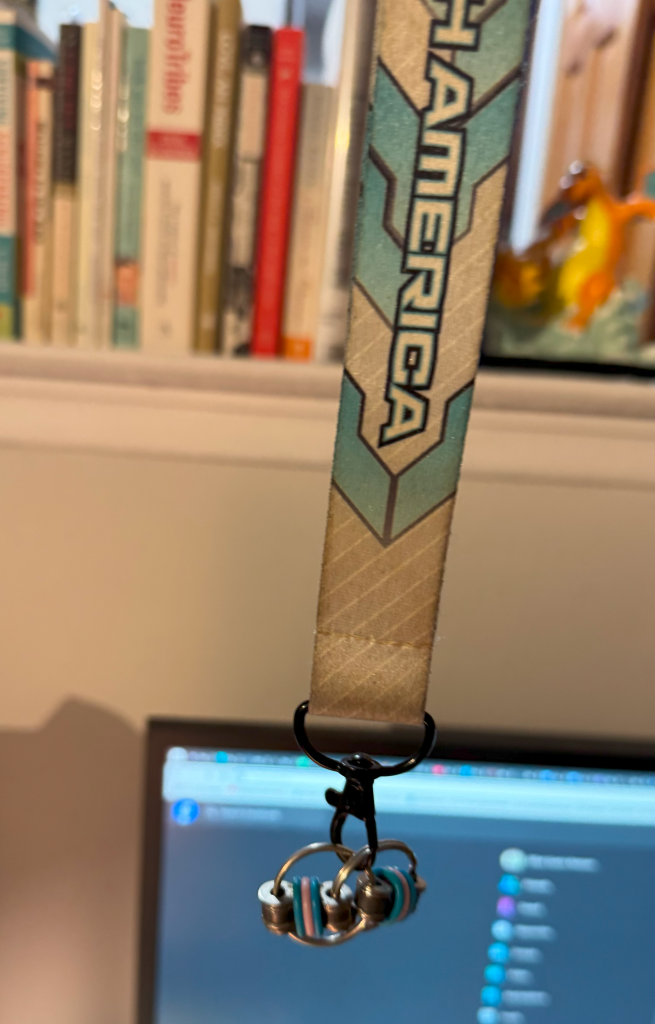
I made this out of a lanyard (this one is from the Pokémon North American International Championships a few years ago) and a bike chain keyring fidget. This is often my go-to stim tool as I wear it around my neck and don’t have to fumble around in my bag for it. It’s also pretty cheap; there are multiple Etsy listings for $5 plus shipping (like this one) and even listings for fun pride-themed colorways which I might just buy right now! Be right back! (By the way, I have no affiliation with any of the products I may link to in this article, nor am I receiving any compensation for including them.) Anyway, these little fidgets are silent, small, and I think they make a particularly satisfying stim for people who may be prone to skin picking. And you can use any lanyard your heart desires!

Now, onto the actual stim kits…

Pocket kit

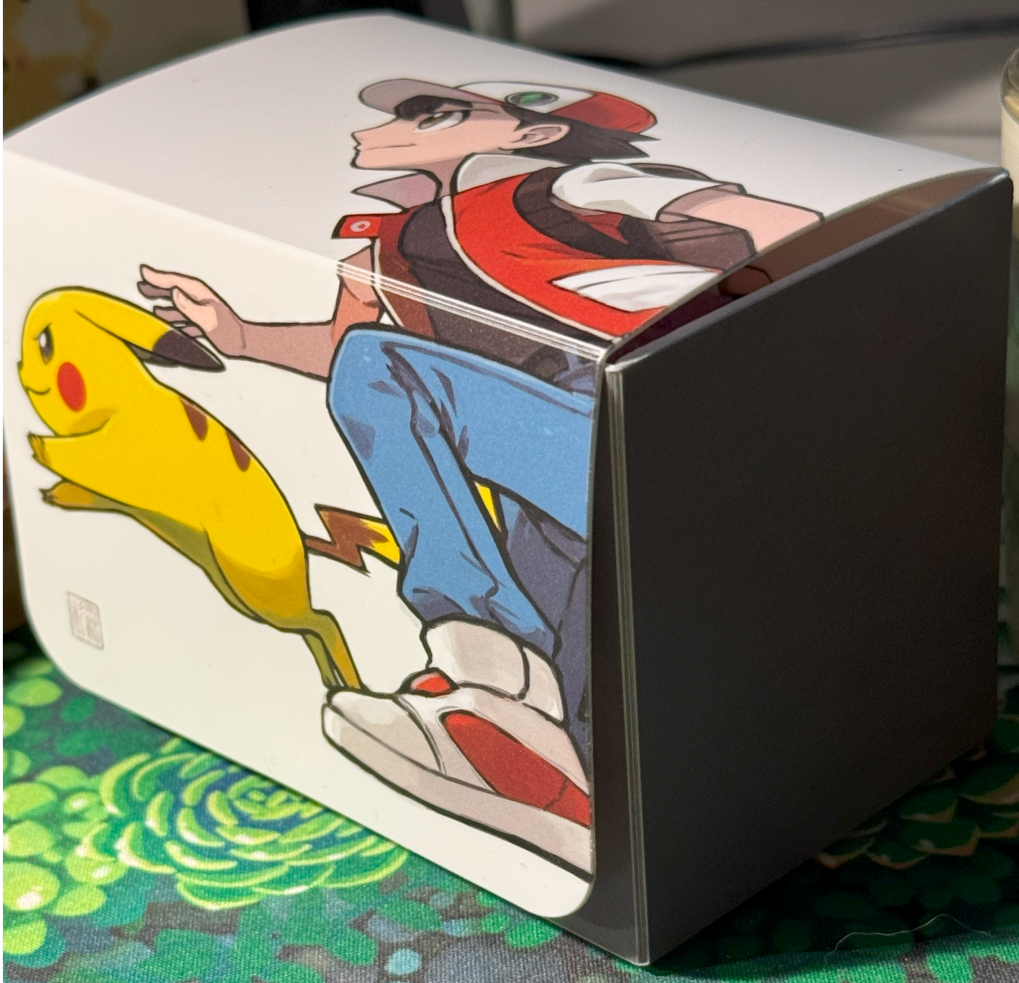
I’ll call the smallest one the “pocket kit” because it just fits in the front pockets of my jeans (American Eagle Womens’ Jeggings). It easily fits in the front pocket of my mini backpack, as well as my bigger backpacks. As you can see, I’m using a Pokémon box (this will be a theme) which is on sale at the Pokémon Center for $20. It also comes with dice and cute status markers for playing Pokémon Trading Card Game, but my favorite asset was this box. So what’s in it?

  • Magnetic Haptic Slider from clickbricks — I like this stim tool a lot! It’s not completely silent, but it’s quiet enough to fly under the radar in most situations. To me it feels kind of like flicking a lighter, which is something I do… a lot.
  • Another keyring bike chain fidget!
  • Nicotine gum, for reasons stated above…
  • One stick of Crystal Light lemonade and one bag of Tazo Earl Grey tea.

I’m looking for new stim tools that will fit in the pocket kit, so if you have any recommendations, please send them to me! I really want to hear from you.

Next, the medium kit…

Medium Kit

This one is also related to Pokémon! It’s a Japanese deck box. One of my favorites, so it seems fitting I put some stim tools in there. If you’re not familiar with deck boxes, they are generally not too large. I think this one is around 3 in (height) x 3 in (depth) x 4 in (width). The NeeDoh Nice Cube just fits inside.

  • NeeDoh Nice Cube — I love this squishable sensory tool! It’s a little bit like a stress ball but it feels soft/gooey, almost like putty or slime. It’s not as sticky, though. It’s got a nice weight to it and the size is perfect for my hands. That said, they make other products at NeeDoh; the cube is probably the most popular.
  • Infinity Cube — I got this one at a gas station somewhere on Long Island, but the Etsy creator who I linked carries some really cool colors and right now they’re on sale for $3. Totally worth it! Infinity cubes can be folded into different configurations almost, well, infinitely. I’ve enjoyed using this one for years now. It’s a tried and true inclusion.
  • Fidget Cube — The fidget cube isn’t my favorite fidget, but I do like some of its functionalities. It is nearly silent. I like the buttons (especially the clicky ones, which do make a subdued sound) as well as the switch/lever and the thumbpad (circular appendage).

That’s right… everything in the medium kit is a cube! (✿◡‿◡) A happy little accident.

Large kit

Now, I don’t want to lie to you, so here it is: a fidget spinner can just barely fit in the deck box I’m using for the medium kit. But, I’m afraid of doing damage to the box by overloading it… so my 2 fidget spinners were included in this amazing bag I got from the Pokémon Center. It’s sparkly! But any toiletry bag should do. Pick your favorite or buy one that suits you!
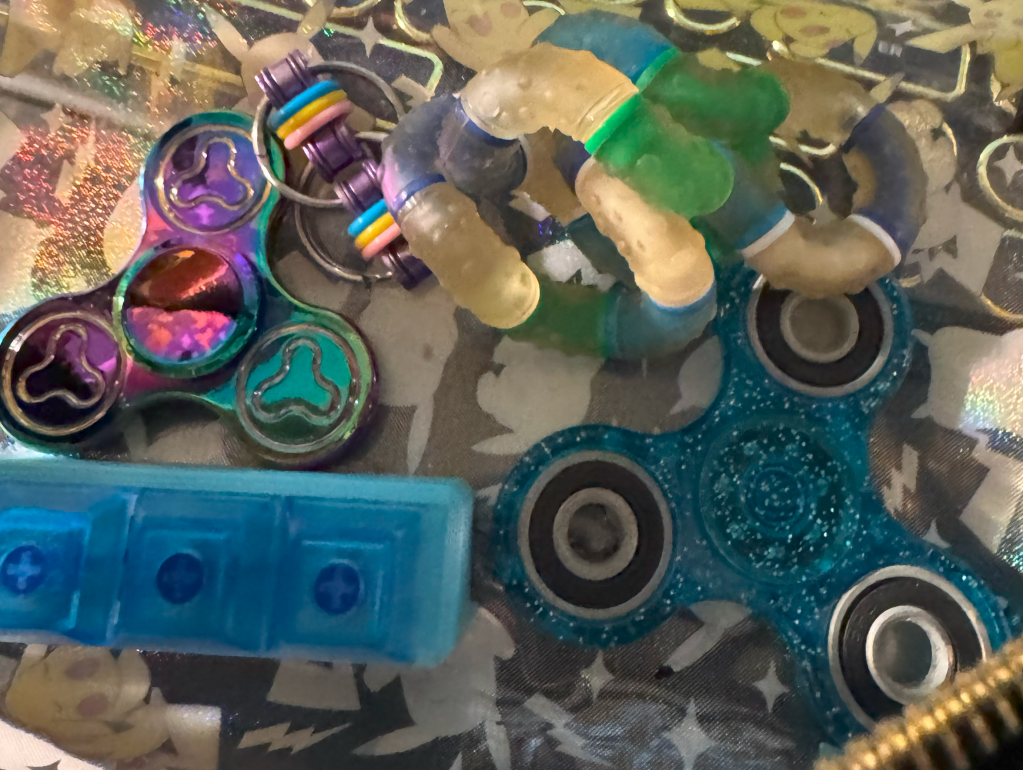
  • 2 fidget spinners — The blue sparkly one is plastic and lighter than the iridescent metal one. They were both gifts and I quite enjoy using them during long lectures.
  • Another bike chain keyring fidget in “unicorn” colors.
  • Tangle Therapy Relax — Has textured segments with a slightly give to them. I generally like to manipulate it in my hand and don’t like pulling the pieces apart, but Tangles are good for either!
  • Keyboard fidget — This uses mechanical keyboard testers as a stim tool! Mine is 4×1 keys and uses Blue switches (Cherry MX I believe?), so it’s quite clicky and noisy, like typing on a typewriter. However, this listing on etsy says they also have linear switches (which are much quieter) and I bet they could even use both!

Have I missed an important stim? Let me know in the comments!

Atmosphere stims

There are some stim tools that can’t be carried around in a box or a bag, but rather, are meant to be used at home or in a private space. Here are some of those things:

  • Candles/incense/air freshener — I highly recommend Morning Star incense!! They even come with a little holder.
  • Weighted blanket or sleep pod
  • Bubble bath or epsom salts
  • Large stuffies — I have a Pikachu!
  • Swings, indoor or outdoor
  • A medium-sized fan — or bigger; for summer

So that’s what I’ve learned! Share in the comments your favorite stim tools and how they help you!


If Autism Isn’t a Mental Illness, What Is?

My name is Elliot. I’m an autistic psychologist with bipolar 1 disorder (and ADHD). I’ve been mentioned in passing [1] [2] in news articles about autistic autism researchers, but I prefer to keep on the science side of things. I usually only use Twitter for personal entertainment, sometimes biting my tongue as I weigh the pros and cons of engaging in autism discourse. I don’t entangle myself too deeply in advocacy work. For the most part, I keep my opinions on controversial things low-key no matter which side I am on. This post is a divergence from that tendency.

I have not uncommonly heard people object to classifying autism as a mental illness. It’s almost taken for granted that autism doesn’t fall under that umbrella. You may be surprised to know how people try to justify it if you actually ask them “Why isn’t it a mental illness?” Indeed, when pressed the most common responses are along the lines of:

  • “Autism is a neurodevelopmental disability” / “You’re born with autism”
  • “Autism isn’t an illness” / “Autism doesn’t need to be treated”
  • “Autistic people aren’t like *those* people”

The common element in all of these responses is a lack of understanding of what mental illness is and what mentally ill people experience. The question I want to ask back is this: If autism isn’t a mental illness, what is?

I’m not unsympathetic to the cause of not labeling people as having an “illness” because they’re neurodivergent, but why is it okay to do it to schizophrenic folks and not to autistic folks? There are plenty of mad people who don’t exactly view their diagnosis as an illness, although opinions in the psychiatric community are varied on this topic. Some consider diagnostic labels to be a prison, and others a gift. We sure live with plenty of labels.

Pharmaceutical drug labels.

Mental illness takes many forms. Some of them are quite properly classified as “neurodevelopmental disabilities” (including schizo spec, bipolar disorder, and ADHD — among possibly many others). The disorders I just mentioned are predominantly caused by genetics, and are therefore present at birth. The expression does change over time — but don’t autistic people have qualities that change as they grow and learn?

People refuse to acknowledge the close similarities between autism and schizophrenia (and other severe mental illness).

I’m going to flat-out recognize this: I think a lot of our community is biased. There are a lot of autistic people that are sanist, and they’ve been permitted to perpetuate misunderstanding.

My own therapist once tried to convince me after I admitted to experiencing delusions earlier in the week that I was merely referencing thoughts that were “overly rigid” as a result of my autism. My psychotic symptoms were being falsely attributed to my autism, and a lack of care was being given where care was needed.

And in the real world autistic people are at high risk of being mistaken for schizophrenic and taken to an ER for psych evaluation when they’re in distress. People can be treated horribly. But instead of stepping back and saying “Why do we treat mentally ill people horribly?” we’ve decided that allyship is not for us and we double down on “Autism isn’t a mental illness.” We cast non-autistic (and some autistic!) neurodivergent people as the Other.

To be quite honest, I think some autistic people are scared of crazy.

Perhaps they’re scared of people who may be erratic, hard to predict, or have dramatic emotional reactions.

A person wearing black Converse and a blue hoodie.

Are there reasons to set autism apart from conditions we consider “mental illness”? I just don’t see the justification for viewing autism as so singularly unique from other conditions. It’s possible that, in the future, we could redefine and do away with the label of “mental illness” altogether. I’ll be interested to see how language evolves for neurodivergent folks. I hope even moreso that people in the autistic community approach the psychiatric community with an open mind, and not with fear or prejudice. I see hope for a future of cross-disability solidarity.


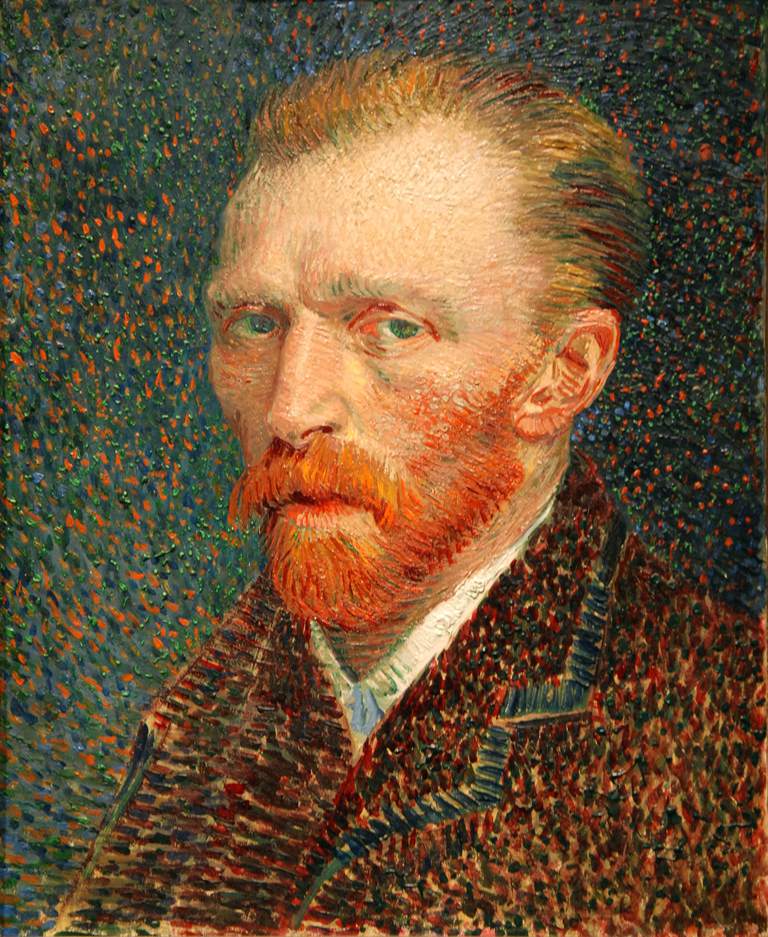
Was Vincent van Gogh autistic?

There’s no doubt in my mind that Van Gogh had bipolar disorder. He had many symptoms related to bipolar disorder: manic episodes, depressive episodes, hallucinations, sleep disturbance, substance abuse, memory problems, nightmares, and anxiety, to name a few from his asylum files.

Yet, additional diagnostic labels could help to clarify his overall presentation. One diagnosis that has been put forward is BPD. It does seem to explain some of the events of his life, for example, his heated interpersonal conflicts and fears of abandonment related to Paul Gauguin. However, a diagnosis of autism has not been seriously considered. This is interesting in light of the heightened prevalence of bipolar disorder in autism — an autistic person is as much as 8.5 times more likely to have bipolar disorder than a non-autistic person (this number assumes no intellectual disability and a diagnosis before age 28).1 Another study found that 7% of autistic people also had bipolar disorder.2

As a child Van Gogh was described by his younger sister as “intensely serious and uncommunicative, and walked around clumsily as if in a daze, with his head hung low”, and went on to say that he was like a stranger both to his siblings and to himself. A servant said he was “an odd, aloof child who had queer manners and seemed more like an old man” than a child.3 These are characteristics often ascribed to some autistic children, even poor motor coordination (dyspraxia).

Vincent was deeply intelligent, thoughtful, and demonstrated what seemed like the capacity to be successful, but as a young man he struggled to find a vocation that could accommodate him. He drifted from an art dealership (where he was fired for arguing with buyers), to a teaching job, to a minister’s assistant for a Methodist church, to a bookshop where he reportedly doodled and translated parts of the Bible into English, French, and German, to religious studies. He failed his entrance exam in theology and his missionary course. Religion was a special interest for Van Gogh. He was endlessly devoted and passionate about the subject, but his odd behavior made him an ineffective preacher, and he was not a good student.

Van Gogh had severe social problems which seem to have started early in his life. People repeatedly thought that he was odd, and they didn’t want to be around him. His peculiarities were off-putting. Children were scared of him. Scholars suggest that he did not understand the concepts of diplomacy or salesmanship, that he lacked insight into the thought processes of others, and lacked the ability to cognitively understand their emotions and motivations.3 He was emotionally dysregulated and prone to agitated or impulsive meltdown behaviors. As his interest in painting became more intense and all-consuming, he neglected maintenance of his body or appearance, appearing even more eccentric.

One of the highlights of Van Gogh’s medical files that has yet to be parsimoniously explained is his chronic stomach issues. In particular, gastrointestinal problems seem to be an important feature of autism4 although bipolar disorder may also be related to stomach problems.

Vincent van Gogh (Dutch, 1853 – 1890 ), Green Wheat Fields, Auvers, 1890, oil on canvas, Collection of Mr. and Mrs. Paul Mellon

Finally, there’s the most obvious trait of Van Gogh’s: his artistic ability. Many people have suggested that Vincent might have had some form of synesthesia. Further, I hypothesize that hue discrimination may, like pitch discrimination, be enhanced in some autistic people.5

A diagnosis of autism didn’t exist in Van Gogh’s time — in fact, wouldn’t exist for over 50 years after his death. Perhaps it’s not so surprising that the autism connection has been overlooked. Vincent van Gogh’s wild, reckless nature combined with intellectual and artistic sensibilities (and lack of mathematical talent) defies narrow stereotypes of autism, yet embodies a certain reality of it: he was thoughtful yet lacked insight, seen as a stranger by the world around him while experiencing the world as fundamentally strange, and possessed incredible gifts yet was understood as deficient. Maybe it’s time to look beyond famous scientists and mathematicians for autistic historical figures.

References

1. Selten J-P, Lundberg M, Rai D, Magnusson C. Risks for nonaffective psychotic disorder and bipolar disorder in young people with autism spectrum disorder: A population-based study. JAMA Psychiatry. 2015;72(5):483-489. doi:10.1001/jamapsychiatry.2014.3059

2. Skokauskas N, Frodl T. Overlap between autism spectrum disorder and bipolar affective disorder. Psychopathology. 2015;48(4):209-216. doi:10.1159/000435787

3. Butterfield, B. The Troubled Life of Vincent Van Gogh. Vincent van Gogh website. September 21, 2002. Accessed May 24, 2020.
http://www.geocities.com/Paris/Louvre/9633/VincentVanGogh.htm

4. Adams JB, Johansen LJ, Powell LD, Quig D, Rubin RA. Gastrointestinal flora and gastrointestinal status in children with autism – comparisons to typical children and correlation with autism severity. BMC Gastroenterol. 2011;11. doi:10.1186/1471-230X-11-22

5. Heaton P, Williams K, Cummins O, Happé F. Autism and pitch processing splinter skills: A group and subgroup analysis. Autism. 2008;12(2):203-219. doi:10.1177/1362361307085270