Stim Kits for Neurodivergent People

A little while back, I started looking around to make a kit of stim tools that I could use to help me sit through long meetings and lectures. Although the combination I’ve settled on (for now) isn’t perfect, I thought it might be helpful to share what I’ve learned and what I’m doing right now.

Why use stim tools?

It’s widely known that autistic people make use of stim tools like the ones I’m going to be talking about. For autistic people, using stim tools may be a method of stimming or “repetitive behaviors”. Many ADHDers use stim tools as well. However, it’s not just autistics and ADHDers who can benefit; for example, bipolar people can definitely use them, particularly in a manic (or mixed) phase. Stim tools can also be used by people who struggle with compulsive behaviors like skin picking (dermatillomania) or hair pulling (trichotillomania). Finally, stim tools can be used to help anyone, regardless of diagnosis!

Making a stim kit

I started out making a single stim kit, but I soon found it might be more beneficial to make several kits of different sizes. However, the first “stim kit” I want to talk about doesn’t usually come out of a box or a bag — I’m talking about wearable stim tools! Chewable necklaces are very popular among people who bite their nails or non-chewable objects such as pencils. Mine, though, is a little different…
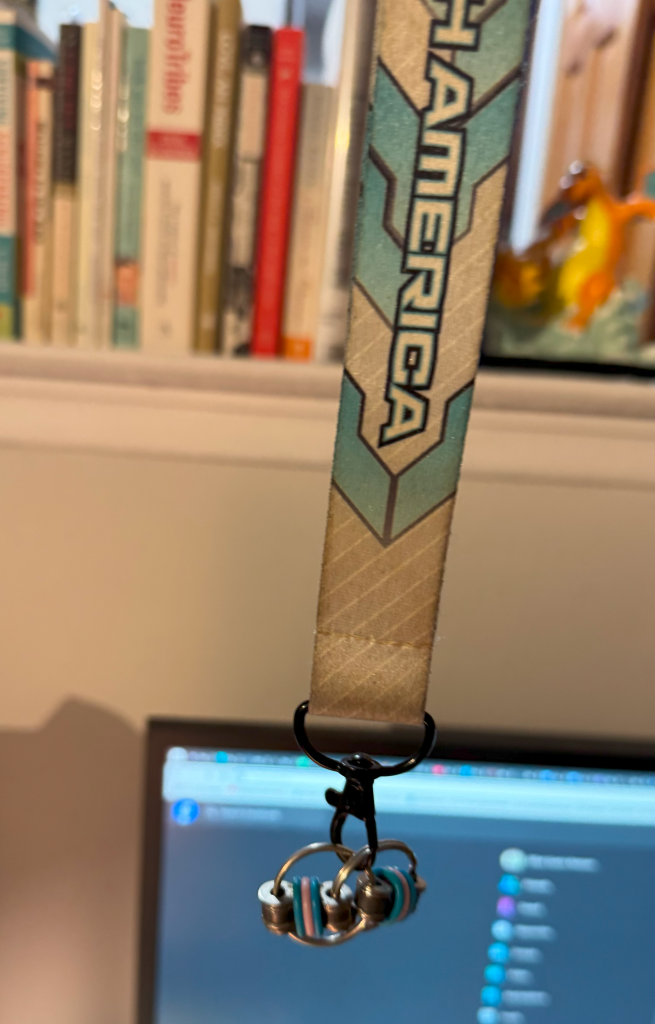
I made this out of a lanyard (this one is from the Pokémon North American International Championships a few years ago) and a bike chain keyring fidget. This is often my go-to stim tool as I wear it around my neck and don’t have to fumble around in my bag for it. It’s also pretty cheap; there are multiple Etsy listings for $5 plus shipping (like this one) and even listings for fun pride-themed colorways which I might just buy right now! Be right back! (By the way, I have no affiliation with any of the products I may link to in this article, nor am I receiving any compensation for including them.) Anyway, these little fidgets are silent, small, and I think they make a particularly satisfying stim for people who may be prone to skin picking. And you can use any lanyard your heart desires!

Now, onto the actual stim kits…

Pocket kit

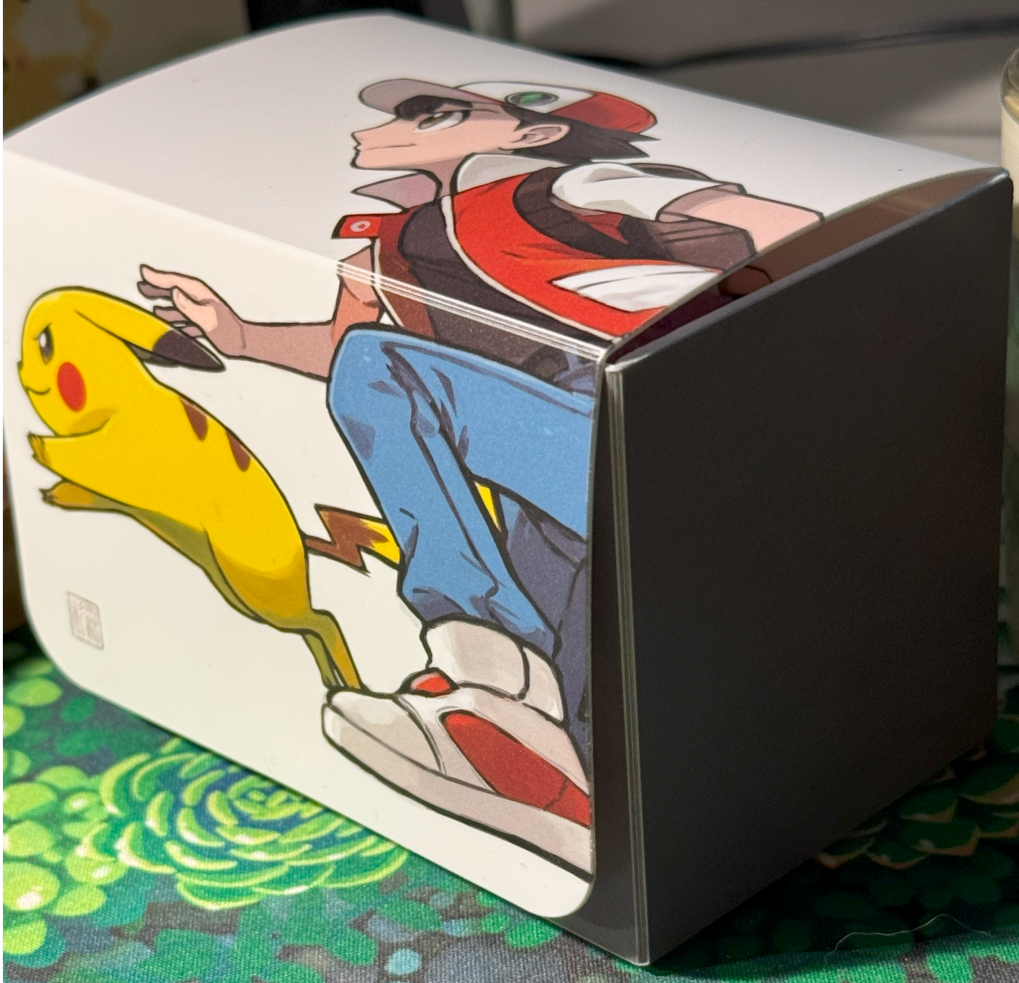
I’ll call the smallest one the “pocket kit” because it just fits in the front pockets of my jeans (American Eagle Womens’ Jeggings). It easily fits in the front pocket of my mini backpack, as well as my bigger backpacks. As you can see, I’m using a Pokémon box (this will be a theme) which is on sale at the Pokémon Center for $20. It also comes with dice and cute status markers for playing Pokémon Trading Card Game, but my favorite asset was this box. So what’s in it?

  • Magnetic Haptic Slider from clickbricks — I like this stim tool a lot! It’s not completely silent, but it’s quiet enough to fly under the radar in most situations. To me it feels kind of like flicking a lighter, which is something I do… a lot.
  • Another keyring bike chain fidget!
  • Nicotine gum, for reasons stated above…
  • One stick of Crystal Light lemonade and one bag of Tazo Earl Grey tea.

I’m looking for new stim tools that will fit in the pocket kit, so if you have any recommendations, please send them to me! I really want to hear from you.

Next, the medium kit…

Medium Kit

This one is also related to Pokémon! It’s a Japanese deck box. One of my favorites, so it seems fitting I put some stim tools in there. If you’re not familiar with deck boxes, they are generally not too large. I think this one is around 3 in (height) x 3 in (depth) x 4 in (width). The NeeDoh Nice Cube just fits inside.

  • NeeDoh Nice Cube — I love this squishable sensory tool! It’s a little bit like a stress ball but it feels soft/gooey, almost like putty or slime. It’s not as sticky, though. It’s got a nice weight to it and the size is perfect for my hands. That said, they make other products at NeeDoh; the cube is probably the most popular.
  • Infinity Cube — I got this one at a gas station somewhere on Long Island, but the Etsy creator who I linked carries some really cool colors and right now they’re on sale for $3. Totally worth it! Infinity cubes can be folded into different configurations almost, well, infinitely. I’ve enjoyed using this one for years now. It’s a tried and true inclusion.
  • Fidget Cube — The fidget cube isn’t my favorite fidget, but I do like some of its functionalities. It is nearly silent. I like the buttons (especially the clicky ones, which do make a subdued sound) as well as the switch/lever and the thumbpad (circular appendage).

That’s right… everything in the medium kit is a cube! (✿◡‿◡) A happy little accident.

Large kit

Now, I don’t want to lie to you, so here it is: a fidget spinner can just barely fit in the deck box I’m using for the medium kit. But, I’m afraid of doing damage to the box by overloading it… so my 2 fidget spinners were included in this amazing bag I got from the Pokémon Center. It’s sparkly! But any toiletry bag should do. Pick your favorite or buy one that suits you!
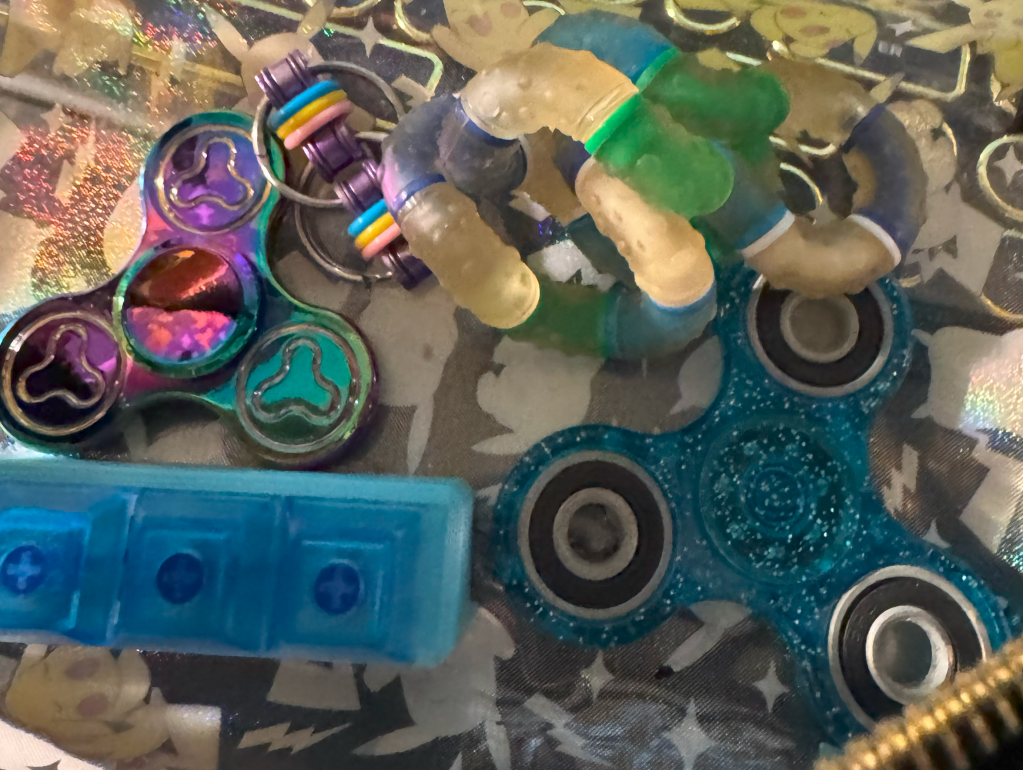
  • 2 fidget spinners — The blue sparkly one is plastic and lighter than the iridescent metal one. They were both gifts and I quite enjoy using them during long lectures.
  • Another bike chain keyring fidget in “unicorn” colors.
  • Tangle Therapy Relax — Has textured segments with a slightly give to them. I generally like to manipulate it in my hand and don’t like pulling the pieces apart, but Tangles are good for either!
  • Keyboard fidget — This uses mechanical keyboard testers as a stim tool! Mine is 4×1 keys and uses Blue switches (Cherry MX I believe?), so it’s quite clicky and noisy, like typing on a typewriter. However, this listing on etsy says they also have linear switches (which are much quieter) and I bet they could even use both!

Have I missed an important stim? Let me know in the comments!

Atmosphere stims

There are some stim tools that can’t be carried around in a box or a bag, but rather, are meant to be used at home or in a private space. Here are some of those things:

  • Candles/incense/air freshener — I highly recommend Morning Star incense!! They even come with a little holder.
  • Weighted blanket or sleep pod
  • Bubble bath or epsom salts
  • Large stuffies — I have a Pikachu!
  • Swings, indoor or outdoor
  • A medium-sized fan — or bigger; for summer

So that’s what I’ve learned! Share in the comments your favorite stim tools and how they help you!

Theories about stimming

Whatever you want to call them — stims, repetitive behaviors, stereotypies — the terms are more-or-less interchangeable, but it remains that they are of importance in how we think about autism. The repetitive behavior/restricted interests domain is essential to an autism diagnosis. Autistic people, when asked, mostly seem to believe this is an important part of autism. Strangely, very few people have undertaken empirical research to validate (or challenge) common ideas about the nature of stimming.

For those who don’t know: what is stimming? There’s actually some variation in what people consider stims, but I think most people would agree that it includes rhythmic, repetitive movements of the body such as rocking, hand flapping, and pacing. Many people include vocalizations such as grunting or whistling. Based on the conventional description of some autistic children having a fascination with parts of objects (like the wheels on a toy car), I feel manipulation of items such as fidget toys and spinners should be counted as well.

Wheee!

Of course, then we’re get into restricted interests territory. Restricted interests and repetitive behaviors are counted in the same “domain” in the DSM, along with sensory atypicalities. In my view, they blend into each other, forming a continuum — but more on that later.

If you asked me, I’d say there’s a lot we don’t know about this topic. A lot of people have beliefs, for sure, but there’s little to no real evidence. At least, not the kind of evidence you can cite.

Most of the knowledge that’s out there comes from the beliefs of autistic community members. Dr. Steven Kapp (who is, coincidentally, a friend) did a qualitative analysis of 31 autistic people’s opinions on stimming.1 Nobody said they disliked their stimming; most people said they found it calming. The study thusly found that stimming most likely serves a regulatory function, and identified three factors that autistic people said caused their stimming behavior: overwhelming environment/sensory overload, noisy thoughts, and uncontainable emotion.

It’s interesting to me that nobody in this study mentioned under-stimulation of sensory input.1 They seemed more to believe that stimulation in excess of a certain individual or situational threshold was the primary cause, and in this case the “stimulation” could be an internal stimuli (a thought or an emotion).

It’s such a simple theory that it seems baffling that nobody has really tested it. Why is that important? Well… sometimes, as humans, things aren’t what we expect them to be. I know a lot of people will react negatively to that sentiment, but I’m autistic too, so it really is an everyone thing. A lot of psychology (ex, cognitive psychology) is actually not self-evident, and may be counter-intuitive. For example, people are not particularly good at judging how they best learn. People overestimate the benefit of massed rehearsal (cramming for an exam) because they feel like it helps them remember more than spaced rehearsal (studying every night), even after seeing evidence that spaced rehearsal results in better task performance.2

Don’t get me wrong, metacognitive insight is valuable — it’s my own greatest weapon! — but it helps to have evidence to back it up. (Likewise, it helps to have qualitative information to back up empirical results.) So why don’t we have studies about this?

Massed practice is inferior to spaced practice, even though you think it’s not.

One study that has been done (although, again, not an empirical study) used Bayesian statistical principles to think about the mechanisms of cognition in autism.3 They concluded that autism features atypical accuracy of predictions — or, more precisely, that they did not use as much prior knowledge in their perception, leading to potentially more accurate perceptions of the world. However, this makes ambiguity and uncertainty very difficult to deal with. The authors use this framework to understand stimming as a means of reducing the uncertainty in the environment, and thereby reducing the sense of alarm or sensory overload experienced by that person.

As I mentioned, repetitive behaviors blend together with restricted interests. Something I’ve become interested in is the role of perseverative or repetitive thoughts and its relation to the role of repetitive behaviors. I explored this idea a little bit in my first paper,4 but I have yet to truly investigate my thoughts on the matter as much as I would like. Here’s my underlying theory: autistic children, as children, have both repetitive behaviors and repetitive thoughts. Normally, these two processes inhibit each other. This seems to corroborate well with the accounts of “noisy thoughts” being a precursor for stimming behaviors to control them.1 However, when children with normative verbal ability become older, they stop doing repetitive behaviors — leading to increased repetitive thoughts, which my study found could be a risk factor for developing depression.4 This might explain, at least in part, why rates of depression are highest in autistic adults with more normative verbal ability. And it lines up quite well with what the autistic people in Kapp’s study said: they identified others’ tolerance of their stims as a matter of acceptance vs. devaluation.1

Do you have any theories?

References

  1. Kapp, S. K., Steward, R., Crane, L., Elliott, D., Elphick, C., Pellicano, E., & Russell, G. (2019). ‘People should be allowed to do what they like’: Autistic adults’ views and experiences of stimming. Autism, 23(7), 1782–1792. https://doi.org/10.1177/1362361319829628
  2. Logan, J. M., Castel, A. D., Haber, S., & Viehman, E. J. (2012). Metacognition and the spacing effect: The role of repetition, feedback, and instruction on judgments of learning for massed and spaced rehearsal. Metacognition and Learning, 7(3), 175–195. https://doi.org/10.1007/s11409-012-9090-3
  3. Pellicano, E., & Burr, D. (2012). When the world becomes “too real”: A Bayesian explanation of autistic perception. Trends in Cognitive Sciences, 16(10), 504–510. https://doi.org/10.1016/j.tics.2012.08.009
  4. Keenan, E. G., Gotham, K., & Lerner, M. D. (2017). Hooked on a feeling: Repetitive cognition and internalizing symptomatology in relation to autism spectrum symptomatology. Autism, 2012, 136236131770960. https://doi.org/10.1177/1362361317709603