Understanding BPD vs. Bipolar: Key Differences Explained

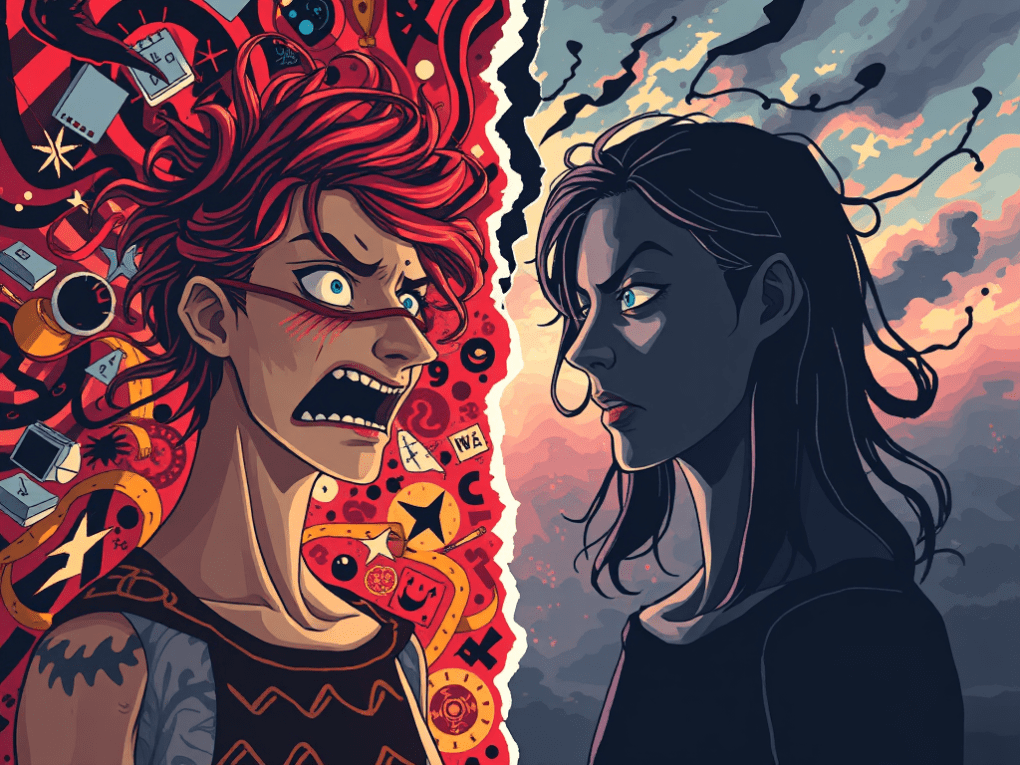
BPD, which stands for Borderline Personality Disorder, has significant areas of overlap with bipolar disorder. Both disorders implicate a breakdown in the emotion regulation areas of the brain. But what are the differences? Cross-sectionally, they’re sometimes quite difficult to tell apart. More differences emerge when looking longitudinally across time.

  1. Bipolar is episodic and predictable in the short term: episodes of mania and depression (and mixed episodes) come and go in a fairly predictable fashion. Some people have depression first and then fly into mania, while others start out with a manic episode and then crash into the depression. It’s roughly 50-50 between these patterns, but within individuals the pattern stays consistent. Which is to say, if you’re a mania first bipolar, you’ll most likely always be mania first.
  2. BPD breakdowns tend to be triggered by some situation the person has found themselves in. Their responses may be over-exaggerated but there is some kind of trigger. Bipolar episodes can also be triggered sometimes, but classically, bipolar episodes can occur with no trigger at all. They’re related to a sort of internal thermostat which is broken. Thus, time of year — and changes in sunlight, which affects this internal thermostat — can be triggers for bipolar disorder, and less likely for BPD.
  3. Psychosis is much more pronounced in bipolar disorder than in BPD. The classic euphoric mania with grandiose delusions come to mind; in bipolar disorder, psychosis is limited to mood episodes and is almost always mood-congruent. (Meaning, someone with classic euphoric mania might have grandiose delusions that they are a very important person or have special powers or abilities; meanwhile, someone in a mixed episode might hear muffled voices that make them feel very paranoid about who might be watching, and they see bugs crawling all over the walls. Okay, the mixed episode examples are psychotic features I have experienced myself.) BPD people may experience transient, stress-related psychosis, but they don’t hold onto it as strongly as bipolar people.
  4. Sleep and changes in sleep are arguably the most important symptoms for bipolar people. Not sleeping enough feeds into mania, while sleeping too much feeds into depression. The relationship between BPD and sleep is less clear. Lack of sleep may worsen emotion regulation challenges. People with BPD who don’t get enough sleep are likely to be irritable during the day.

Bipolar Disorder vs. Manic Depression: Importance of Lived Experience

You may have heard that Bipolar Disorder used to be known as Manic Depression. This was the case until 1980, with the advent of the DSM-III. The committee over at the APA who decides these things had three goals in mind when they changed the name:

  1. Reduce stigma — The APA saw that the term “manic depression” had become highly stigmatizing.
  2. Provide a more accurate and clinical description of the condition
  3. Reflect the alternating periods of mania and depression that characterize the disorder — more on these in a minute.

I want to clarify that while the APA laid out the missions above, they did not consult the community members who live with the condition. Many people, some of them high profile (like Kay Redfield Jamison) still prefer the term manic depression still today. To change the name of a disorder without extensive community feedback feels like a violation of autonomy for those of us who live with a severe mental illness.

But let’s address the three goals laid out by the APA with the publication of the DSM-III…

  1. Although it’s very likely true that the term “manic depression” had become highly stigmatized, it seems a bit odd to assume that the stigmatization of the disorder came from what we choose to call it, rather than stemming from the people who live with the condition. Case in point, today “bipolar” is highly stigmatized and used inappropriately for a number of reasons — to refer to indecisive weather patterns, people we don’t like, and a host of other things. It’s just as bad as manic depression ever was. Why? Well, maybe the problem wasn’t the term manic depression. The stigma was never attached to the term. The stigma is attached to those of us who live with the condition, regardless of what you choose to call it. No matter how many times you change the name of the disorder, that truth would never change.
  2. Many of us in the bipolar disorder/manic depression sphere actually feel that “manic depression” is much more descriptive of our lived experiences. “Bipolar” exemplifies a particular phenotype, one which is at least somewhat common among bipolar folks (and considered by some to be an archetypal presentation) but to the exclusion of others with more uncommon manifestations of the disorder. If we are to take “bipolar disorder” at face value, I am left to assume that there are two “poles” (opposites) which people oscillate between. However, this ignores the very real and unfortunately common experience of mixed episodes — when the two opposing states of “bipolar” are somehow happening both at the same time. How can they be opposite, when in fact they coexist so frequently?
  3. I don’t think most people who know little about “bipolar disorder” are thinking about its longitudinal dynamics. Many people still believe that bipolar disorder is about quick shifts in mood lasting only a few hours (although these types of episodes do happen in classic bipolar disorder, they are much more rare and occur in the context of other well-known symptoms) or that bipolar disorder is the same as “multiple personality disorder”.

As it turns out, I think manic depression is both more accurate (instead of positing that mania and depression are opposing forces, when in reality, they seem to be linked and can even occur simultaneously) and, in the end, probably less stigmatizing than “bipolar disorder”. This just highlights the importance of including community input (for example, from “bipolar” patients) when making decisions like this.

What do you think? Leave a comment and let us know!


If Autism Isn’t a Mental Illness, What Is?

My name is Elliot. I’m an autistic psychologist with bipolar 1 disorder (and ADHD). I’ve been mentioned in passing [1] [2] in news articles about autistic autism researchers, but I prefer to keep on the science side of things. I usually only use Twitter for personal entertainment, sometimes biting my tongue as I weigh the pros and cons of engaging in autism discourse. I don’t entangle myself too deeply in advocacy work. For the most part, I keep my opinions on controversial things low-key no matter which side I am on. This post is a divergence from that tendency.

I have not uncommonly heard people object to classifying autism as a mental illness. It’s almost taken for granted that autism doesn’t fall under that umbrella. You may be surprised to know how people try to justify it if you actually ask them “Why isn’t it a mental illness?” Indeed, when pressed the most common responses are along the lines of:

  • “Autism is a neurodevelopmental disability” / “You’re born with autism”
  • “Autism isn’t an illness” / “Autism doesn’t need to be treated”
  • “Autistic people aren’t like *those* people”

The common element in all of these responses is a lack of understanding of what mental illness is and what mentally ill people experience. The question I want to ask back is this: If autism isn’t a mental illness, what is?

I’m not unsympathetic to the cause of not labeling people as having an “illness” because they’re neurodivergent, but why is it okay to do it to schizophrenic folks and not to autistic folks? There are plenty of mad people who don’t exactly view their diagnosis as an illness, although opinions in the psychiatric community are varied on this topic. Some consider diagnostic labels to be a prison, and others a gift. We sure live with plenty of labels.

Pharmaceutical drug labels.

Mental illness takes many forms. Some of them are quite properly classified as “neurodevelopmental disabilities” (including schizo spec, bipolar disorder, and ADHD — among possibly many others). The disorders I just mentioned are predominantly caused by genetics, and are therefore present at birth. The expression does change over time — but don’t autistic people have qualities that change as they grow and learn?

People refuse to acknowledge the close similarities between autism and schizophrenia (and other severe mental illness).

I’m going to flat-out recognize this: I think a lot of our community is biased. There are a lot of autistic people that are sanist, and they’ve been permitted to perpetuate misunderstanding.

My own therapist once tried to convince me after I admitted to experiencing delusions earlier in the week that I was merely referencing thoughts that were “overly rigid” as a result of my autism. My psychotic symptoms were being falsely attributed to my autism, and a lack of care was being given where care was needed.

And in the real world autistic people are at high risk of being mistaken for schizophrenic and taken to an ER for psych evaluation when they’re in distress. People can be treated horribly. But instead of stepping back and saying “Why do we treat mentally ill people horribly?” we’ve decided that allyship is not for us and we double down on “Autism isn’t a mental illness.” We cast non-autistic (and some autistic!) neurodivergent people as the Other.

To be quite honest, I think some autistic people are scared of crazy.

Perhaps they’re scared of people who may be erratic, hard to predict, or have dramatic emotional reactions.

A person wearing black Converse and a blue hoodie.

Are there reasons to set autism apart from conditions we consider “mental illness”? I just don’t see the justification for viewing autism as so singularly unique from other conditions. It’s possible that, in the future, we could redefine and do away with the label of “mental illness” altogether. I’ll be interested to see how language evolves for neurodivergent folks. I hope even moreso that people in the autistic community approach the psychiatric community with an open mind, and not with fear or prejudice. I see hope for a future of cross-disability solidarity.


After a suicide attempt

Caution: this post contains explicit discussion of suicide

Two days ago (on September 10th) was World Suicide Prevention Day. Although it is important to address prevention of suicide attempts, the strongest predictor of a fatal (or “completed”) suicide is a history of previous, non-fatal suicide attempts. The risk factors for suicide attempts are more diverse and include: family history of suicide, early onset of bipolar disorder, extent of depressive symptoms, increasing severity of affective [mood] episodes, the presence of mixed affective [mood] states, rapid cycling, comorbid Axis I disorders, and abuse of alcohol or drugs1

Most suicide prevention effort focuses on people who are naive to psychiatric treatment and have reached a crisis point: people who don’t already have a psychiatric point of contact, and usually people who have never been treated in an inpatient setting before. In my experience, most people do not continue using crisis lines or similar services after they have been hospitalized once. Surmounting the fear and stigma around hospitalization itself is a primary reason crisis lines exist. Crisis lines are staffed by severely underqualified volunteers, who are usually following a script, and only have two action moves: call an ambulance, or tell you to go talk to someone else (sometimes your health insurance company). Yet, people find calling a crisis hotline less formidable than simply admitting themselves voluntarily.

But what about those of us with chronic illnesses, with volumes of psychiatric history, who have been admitted many times? This service is clearly not meant for me. If I spoke to a crisis line on what to me is an an average day, I might find myself being dragged to the ER and with an $800 ambulance fee to boot. There is no exception for chronicity. The stakes of a mistake are high, and the crisis line operator is equipped with a high school diploma.

There’s a gap between services for first-episode patients and services for profoundly disabled people who live in an institutional setting. After my close-to-fatal suicide attempt about two and a half years ago, I had to navigate what exactly life looks like after a serious suicide attempt. I consumed an amount of lithium equal to the 50% lethal dose in rats, and an antidepressant that is also a potent anti-emetic (anti-vomiting) drug. I knew I would absorb more of the lithium if I delayed the onset of (inevitable) severe vomiting.

I was hospitalized for only 16 days. The attending physician treating me thought I should go to a residential treatment program, but I was supposed to be at an academic conference and I begged to be realized in time to go. The head of the clinic evaluated the situation and decided to release me. I was discharged within hours of my flight to Europe. After the conference, I was enrolled in a partial hospitalization day program. The official length of the program was 8 weeks; I was probably enrolled for 4 months. My psychiatrist met with me nearly every day.

We tried a lot of medications, but for quite some time I was not permitted to take lithium. This was unfortunate, because lithium is probably the single most effective drug I take. I have cycled through almost every atypical antipsychotic: Seroquel, Abilify, Vraylar, Zyprexa, Saphris, Geodon… I’m sure I’ve forgotten something, it’s more than I can keep track of. I tried Depakote and Lamictal. Nothing has the same effect as lithium. Ironically, lithium also has a specific anti-suicide effect.

I continued to be suicidal throughout and beyond the partial program. I am lucky that my psychiatrist works well with me.

Chronic suicidality is probably more common than people realize. It doesn’t appear in the media. It’s taboo. You fear to acknowledge it exists somewhere. When we talk about improving mental health services, let’s give a little more attention to the people for whom posting a status update with the s-word in it is reason to panic and report it to Facebook headquarters.

References

  1. Hawton, K., Sutton, L., Haw, C., Sinclair, J., & Harriss, L. (2005). Suicide and Attempted Suicide in Bipolar Disorder: A Systematic Review of Risk Factors. The Journal of Clinical Psychiatry, 66(6), 693–704. https://doi.org/10.4088/JCP.v66n0604


Psychiatric disorders and discrimination by medical professionals

There is much that could be written about the damage done by bad psychiatrists, but this post will specifically focus on non-psychiatric medical professionals: doctors, nurses, everyone involved with it.

Once I presented to the ER with a large abscess from a skin infection, and in great pain. I told the triage nurse that I had this abscess, and showed it to her (it was not subtle). She proceeded to look through my chart and started asking me about my bipolar disorder. I told her what she asked, and of course we got to “Are you planning to hurt yourself?” and I said no, because I wasn’t, I just really needed my abscess to be drained by a doctor.

Naturally, then, she put me in psychiatry and had a psychiatrist come speak to me. I told the psychiatrist what I told the nurse and showed him the abscess. He was horrified by it, and said he’d call my psychiatrist. After he spoke to her, he moved me to the medical area and gave his psychiatric stamp of approval. Finally, a medical doctor arrived and drained my abscess.

In retrospect, is it a big problem? I think it is. What if my condition were even more time-sensitive? They wasted significant time getting me a psych eval when I was not presenting with any major psychiatric symptoms, I just happen to have a chronic mental illness that I will have in my chart forever. What if I was having a heart attack? Would I have to get a psych eval because I’m bipolar?

If you have a label like “bipolar disorder type 1” they will always look for a psychiatric cause for your symptoms, even when the evidence doesn’t suggest it’s psychiatric (like, the huge abscess). They assume you are professionally crazy and anything you say is cause for suspicion, instead of an honest report of symptoms. Putting patients presenting with tangible physical illness in the psych area just because they have a diagnosis, but are not presenting with symptoms, is discrimination.


Anxiety and mania

Recently, The Mighty published an article about the differences between anxiety and hypomania. However, I wanted to complicate the discussion by bringing up something that breaks the juxtaposition of anxiety and mania: primarily anxious mania, which is most likely a mixed episode associated with bipolar type 1.

The author describes how her anxiety leaves her “immobilized”. This can actually happen in mania, too — but usually not in hypomania. Hypomania is often very productive. Full mania is no longer productive — it’s frantic, potentially confused, and may be characterized by manic stupor. Emil Kraepelin used this term to describe a flight of ideas and elevated mood (not necessarily happy, but revved-up) combined with psychomotor slowness or immobility. I’ve been in this state, and I experienced it subjectively as intense feelings of anxiety paralyzing my every move. This might also be referred to nowadays as catatonia, and something similar can occur in severe depressive states; however, the catatonia that coincides with mania is likely excited catatonia (characterized by purposeless movements rather than being completely still).

Hypomania isn’t rare, exotic, or exciting to me. It’s just part of my life, and I take advantage of it when it comes around — which it will, no matter what. But, to me, full mania is to be avoided. Anxiety is also a daily part of my life, but the anxiety and paranoia I experience during a manic episode is even more excruciating than it usually is. Juxtaposing them as discrete, separate states can only take you so far in understanding what mania is and how it affects people.


One bipolar person’s drug regimen

Currently, I take 8 medications for psychiatric reasons. I’ve also been on many others — including most of the atypical antipsychotics, several anticonvulsants, antidepressants, and more. These are my current drugs ranked in terms of how essential they are (if, for example, I could only get some of them, perhaps due to a catastrophe):

  1. Lithium — Big Pharma has yet to come up with something better. It could never be patented, it wasn’t paid for by anybody. It actually works. And it’s all-natural. But also, it sucks. Nature is brutal.
  2. Haldol — Indispensable, though I might be switching to Thorazine in the near future. I don’t picture myself living without an antipsychotic again. Typicals seem to work better for me than atypicals did, though I’ve notably NOT tried Risperdal (even though it’s a good fit for my symptoms) or clozapine. Both were considered, though.
  3. Ativan (lorazepam) — My symptoms tend to cluster around anxiety, insomnia, and irritability — maybe paranoia — all things helped by benzodiazepines. If it were not so problematic, I might have ranked it #2. It’s the best immediate symptom relief I can get aside from maybe sublingual Zyprexa (olanzapine).
  4. Adderall — I would never actually achieve anything in life without Adderall. That said, my need to do something with my life is inherently superseded by my need to be alive, which is why it ranks #4.
  5. Lamotrigine (Lamictal) — An anticonvulsant medication. It seems to be doing something, because I become depressed without it. Though I’m not exactly sure what it’s doing.
  6. Gabapentin — I’m supposed to be using it for anxiety to offset my lorazepam use. It’s also useful for severe headaches. I still feel the pain, but I kind of don’t care, like the pain just doesn’t command my attention.
  7. Clonidine — It’s a blood pressure med, but I’m using it for insomnia. I cycle through medications for insomnia because they all lose their effectiveness eventually. I haven’t been on clonidine before so I don’t know how long it will be useful for. Other drugs I’ve used for sleep: Trazodone, Remeron, Ativan, Seroquel (and other atypical antipsychotics)…
  8. Diphenhydramine (Benadryl) — An OTC drug! The original antihistamine. I take it as 50mg softgels (two of them, which is slightly more than the bottle indicates — consult your doctor). Sometimes works for sleep, not super reliable and fades quickly. Useful if I have a cold or flu because Sudafed is not the best choice for my wiring. Also potentially protective against Haldol-induced side effects. So overall, something I take regularly, but not every day.

Anyone want to share their regimen?


I’m lucky to have my bipolar disorder

There are times that I’ve felt cursed by having ultra-rapid-cycling, somewhat-atypically-presenting bipolar 1 disorder. My mood episodes are short (sometimes as short as one day, although usually lasting a few days to a week) and they can be very intense. I also suffer from mixed episodes, which are agonizingly painful to experience, and at times I have had profound suicidality that has led to multiple suicide attempts — one of which left me in a coma for three days and nearly claimed my life. Doctors said I wasn’t going to make it. But I did.

During the worst of times I’ve wished to have “classic” bipolar disorder instead of my bipolar disorder. In truth, “classic” features may be relatively rare; but it conjures the idea of long, bleak depressions punctuated by shorter, but still somewhat long, grandiose and euphoric manias. Separate and distinct periods of each, usually lasting for months at a time, with bouts of clean euthymia (wellness) in between.

I haven’t really experienced prolonged euthymia, instead merely catching glimpses of it over the course of my continuous ups and downs. My manias are “dirty” and dysphoric, tainted with depressive themes. My hypomanias are very productive; but if my mood spikes too high, my thoughts become dark and gruesome. If I were to jump off a building, it would be to kill myself, not because I believed I could fly.

And I’m also a researcher. Without a doubt, my research in the area of bipolar disorder draws upon my insights as a bipolar person. If I had “classic” bipolar disorder, the research I have done (some of it relying theoretically upon data collection of my own personal changes in mood) would not have been possible. Because I’m an ultra-rapid-cycler, I was able to capture long-term patterns that might take many years to become evident in “classic” bipolar disorder. I believe the same patterns exist in both, but when moods last for months at a time, it is harder to see those patterns.

My ability to detect patterns has served me well in life (including in my professional career) and to some extent, my bipolar disorder trained me to do it. Predicting my own mood was not only possible, thanks to the accelerated timeframe, but essential to my ability to cope with them. Part of the devastation of mixed episodes came with the loss of my ability to predict with reasonable accuracy when moods would peak or change and in what direction. Even so, I learned new patterns and slowly became able to tell what a “mixed episode” felt like, and whether I was experiencing one. This was not something I could do at first.

Insight into the emotions, cognitions, and memory issues that come along with my bipolar disorder developed over time, starting at an early age (as I first developed symptoms around the age of 10). In turn, this level of insight has allowed me to hypothesize connections no other researcher has yet seen. I understand firsthand how bipolar disorder intersects with changes in thinking and memory.

I have the opportunity to discern cause and effect in relation to changes in my mood much more easily than someone with “classic” bipolar disorder, thanks to the immediacy of any reactions. Upon hearing from my psychiatrist that nitrates in beef jerky were causally linked to mania, I took note of my own reactions. I had known for quite some time that beef jerky had a stimulant-like effect on me, but I was surprised to learn it did not have this effect on everyone. (Too bad!) I experience this stimulant-like effect almost instantly, while I’m still eating. The temporal proximity of the cause and the effect makes them easier to distinguish.

My bipolar disorder is a blessing and a curse. I have struggled immensely to control it, but I wouldn’t trade it for “classic” bipolar disorder or no bipolar disorder at all. The knowledge and abilities I have gained as a result of my battle with bipolar disorder — my bipolar disorder, not someone else’s — have actually, truly been indispensable to my life and my career. Plus, that excessively productive hypomania is pretty good too.